About 37 minutes
Equation for Time — Story, Setting & Ideas
Space Future
8,359 recorded words. 0 minutes difference from this book's estimate.
View Gutenberg source #64799
This digital edition of Hideout — Text and Context is described by source-level measurements including 8,491 words, 37 min estimated reading time, and 1 detected text section.
The text analysis averages about 18.0 words per sentence, while the detected sections provide another way to judge how the source is divided.
Project Gutenberg metadata also associates the work with “Science fiction,” connecting these edition facts with the source record’s subject description.
Explore this collection
These alternatives are selected using recorded categories and estimated reading time.
About 37 minutes
Space Future
8,359 recorded words. 0 minutes difference from this book's estimate.
View Gutenberg source #64799About 37 minutes
Space Future
8,310 recorded words. 0 minutes difference from this book's estimate.
View Gutenberg source #66396About 36 minutes
Space Future
8,135 recorded words. 1 minutes difference from this book's estimate.
View Gutenberg source #65388Search stored excerpts and compare books → Choose by your preferences →
Choices use stored catalog measurements. Estimates vary with reading speed. A shared category is a catalog label, not a claim that two books have the same argument or literary quality.
Search reads excerpt text stored with this catalog and links to its associated Gutenberg record. The connection is stored in the site database; this tool does not recheck that every excerpt is word-for-word identical to that external record. Excerpt search does not cover every chapter and does not verify historical publication dates.
Catalog snapshot checked: 2026-09-25. Coverage: 90 public books, 90 available source excerpts.
Calculated from edition completeness, EPUB availability, text structure and catalogue metadata. Not a user rating.
Total of 100 points, scaled to a 2.5-5.0 range. Editions with an empty description or a missing EPUB file are not scored.
Public-domain source text
The source text is kept in the dedicated reader, separate from this catalogue record and its commentary.
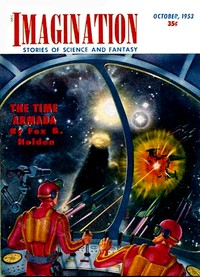
Robbin Cutlass, captain of the space pirate ship Vulture, faces a trap set by the Tri-Planet Entente Space Patrol. Outnumbered two hundred to one, he activates a Raven drive that hurls his vessel not through space but through time. The narrative shifts abruptly from the void of Deep Space to the dusty roads of 1880s Texas, where Cutlass and his crew—now calling themselves the Kid and Chico—plot a stagecoach robbery. The transition is jarring: one moment Cutlass taps an ecliptic deviation pattern on a master control console; the next, he studies a wanted poster offering $5,000 for his capture, dead or alive.
The story's central tension lies in the collision of two settings: the high-tech future of space piracy and the lawless frontier of the American West. Cutlass carries his space-age arrogance into the past, fuming that 'all the tin badges in Texas gang together just to hunt him down like a coyote.' Yet his methods remain unchanged—he uses the same cunning and ruthlessness that made him a feared pirate. The narrative draws explicit parallels: the Patrol's pursuit mirrors the cavalry's ambush, and the reward poster echoes the price on his head in space. Holden reinforces this through recurring details: Cutlass's gold watch, engraved with initials not his own, becomes a symbol of his displaced identity. He cannot remember where the watch came from, just as he cannot fully reconcile his two lives.
The dialogue shifts register between the two settings, yet retains a consistent hard-boiled edge. In space, Cutlass barks orders: 'Track her down! ... Boarders don your suits, man lock stations and stand by.' In the Old West, his speech adopts a folksier cadence: 'Last time you got that greasy trigger finger of yours in an itch an' we had t'go killin' t'get the stuff.' The crew's banter—Gonzales complaining that wanted posters 'don't draw our peectures worth a damn'—adds a wry humor that undercuts the tension. Holden uses these vocal contrasts to highlight the characters' adaptability: they are outlaws in any era, fluent in the idioms of both space and saddle. The Kid's nervous adjustment of his 'black kerchief over his thin nose' echoes the earlier image of Cutlass checking his radar screen, linking the two worlds through gesture.
The surviving excerpts present only the opening and a middle section, leaving the full arc of time travel and resolution unclear. What is visible is a deliberate structural hinge: the story begins in medias res with a space battle, then cuts to a Western heist. The missing portions likely bridge these halves, but the existing text already establishes a pattern of doubling. Cutlass's memory is spotty—'he knew more by instinct than by memory how he'd got it'—suggesting that time travel may have eroded his past. The reader is left with fragments: a watch, a reward poster, a name that may not be his own. Holden's prose mirrors this fragmentation, shifting from technical jargon ('oblique ecliptic eight degrees') to Western colloquialisms ('hell for leather') without transition. The effect is disorienting, forcing the reader to piece together Cutlass's identity alongside him.
Readers should pay close attention to the objects Cutlass carries between eras—the watch, the Raven drive, the wanted poster—as they may serve as anchors for the story's logic of time travel. The incomplete text invites speculation about how the two timelines connect, but the existing material offers a self-contained portrait of a man who cannot outrun his own nature. Holden's blend of science fiction and Western tropes rewards those who enjoy genre hybridity and lean, dialogue-driven storytelling.
Reading about Cutlass trading his starship for a Texas saddle, I caught myself wondering how another stranded man might fare on Mars. That old question of a person out of place, improvising in a world that doesn't want them, keeps echoing. It is a strange comfort, finding that loneliness again in Madmen of Mars — Text and Context, like meeting an old acquaintance.
Save your reaction, strongest insight, and memorable passage.