About 37 minutes
Equation for Time — Story, Setting & Ideas
Space Future
8,359 recorded words. 0 minutes difference from this book's estimate.
View Gutenberg source #64799
The catalog record for Danger in the Void — Key Ideas to Explore provides practical reading context through 8,310 words, 37 min estimated reading time, and 1 detected text section.
The text analysis averages about 15.4 words per sentence, while the detected sections provide another way to judge how the source is divided.
Project Gutenberg metadata also associates the work with “Science fiction,” connecting these edition facts with the source record’s subject description.
Explore this collection
These alternatives are selected using recorded categories and estimated reading time.
About 37 minutes
Space Future
8,359 recorded words. 0 minutes difference from this book's estimate.
View Gutenberg source #64799About 37 minutes
Space Future
8,491 recorded words. 0 minutes difference from this book's estimate.
View Gutenberg source #65843About 36 minutes
Space Future
8,135 recorded words. 1 minutes difference from this book's estimate.
View Gutenberg source #65388Search stored excerpts and compare books → Choose by your preferences →
Choices use stored catalog measurements. Estimates vary with reading speed. A shared category is a catalog label, not a claim that two books have the same argument or literary quality.
Search reads excerpt text stored with this catalog and links to its associated Gutenberg record. The connection is stored in the site database; this tool does not recheck that every excerpt is word-for-word identical to that external record. Excerpt search does not cover every chapter and does not verify historical publication dates.
Catalog snapshot checked: 2026-09-25. Coverage: 90 public books, 90 available source excerpts.
Calculated from edition completeness, EPUB availability, text structure and catalogue metadata. Not a user rating.
Total of 100 points, scaled to a 2.5-5.0 range. Editions with an empty description or a missing EPUB file are not scored.
Public-domain source text
The source text is kept in the dedicated reader, separate from this catalogue record and its commentary.
The trouble starts not with a mechanical failure but with a marriage already in crisis. Four billion miles from Earth, aboard the Arcturus Queen, Silvia Bennet nurses a plan to divorce her husband George at their destination—a plan she has kept secret. Yet within moments of the ship's shudder, a stranger slides into George's vacated seat and names her intention aloud: "Your divorce." The story's tension hinges on who knows what, and how far each spouse will go to escape the other.
Fritch builds the narrative through clipped, combative dialogue and small, telling gestures—Silvia's fingers itching "to make red ribbons of his face," George's habit of walking away from arguments. The setting, a routine interstellar voyage, becomes a pressure cooker where private resentments escalate into lethal contracts.
The Bennets' marriage is presented not as a partnership but as a cold war conducted in plain sight. Silvia's internal fury is matched by George's passive aggression: when she snaps at his curiosity about the ship's trouble, he leaves for the observation platform, a retreat she recognizes as "always his way, running out on an argument." Their exchanges are laced with mutual contempt, yet neither has filed for divorce—each suspects the other will act first. The stranger, Mr. Jones, exploits this stalemate by offering a deadly solution. The story's opening pages establish a domestic dynamic where every word is a weapon and every silence a strategy.
Mr. Jones is deliberately unremarkable: "a rather common face, one with no particularly outstanding features, a face that would be difficult to remember." He wears a plain business suit and speaks with calm authority. Yet he knows Silvia's secret before she admits it, and he names the price for his services: ten percent of the insurance payout. Fritch uses this character to externalize the couple's unspoken violence. Jones is less a person than a function—a mechanism that turns marital resentment into a transaction. His presence forces the reader to ask: how many other passengers have made similar deals? The answer, when it comes, multiplies the story's moral complexity.
In the lifecraft, the story pivots. Silvia, having had second thoughts, tries to call off the contract. Jones refuses: "A contract is a contract." Then George reveals he too hired Jones, and the other passengers admit they did as well—each spouse plotting the other's death, each now trapped with the hired killer. The revelation transforms the narrative from a simple tale of marital betrayal into a layered puzzle of mutual suspicion. Fritch withholds the full backstory—what drove each to this point—but the excerpted text suggests a pattern of desperation and fear. The ending, though incomplete in the excerpts, leaves the reader with a shipboard society where no one is innocent.
Readers should pay close attention to the story's pacing: Fritch compresses a murder plot, a marriage crisis, and a disaster into a few thousand words, using the confined setting of the spaceship to heighten every exchange. The excerpts do not reveal the final fate of the characters, but the pattern of double-crosses suggests that trust, once broken, cannot be easily restored. This is a story best read for its tight construction and its unflinching look at how ordinary people can be pushed to extraordinary measures.
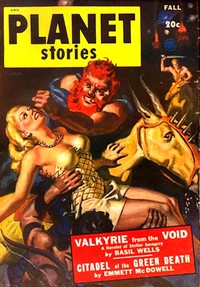
There's something about that stranger in the void—how the couple’s mutual secrets pile up so quietly you almost forget how lonely trust can get. It reminds me of older Fritch territory, where the green death casts its own long shadow over choices we think we've made alone. That haunted patience lingers in Citadel of the Green Death — Themes and Context, and reading it years later, I still feel that same low hum of dread and recognition.
Use these questions to collect your thoughts before moving on.