About 41 minutes
The incredible invasion — A Reader’s Guide
Machines Invention
9,403 recorded words. 0 minutes difference from this book's estimate.
View Gutenberg source #68233
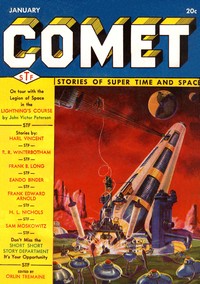
The catalog record for Yesterday's Revenge — Story, Setting & Ideas provides practical reading context through 9,204 words, 41 min estimated reading time, and 1 detected text section.
The text analysis averages about 23.5 words per sentence, while the detected sections provide another way to judge how the source is divided.
Project Gutenberg metadata also associates the work with “Science fiction,” connecting these edition facts with the source record’s subject description.
Explore this collection
These alternatives are selected using recorded categories and estimated reading time.
About 41 minutes
Machines Invention
9,403 recorded words. 0 minutes difference from this book's estimate.
View Gutenberg source #68233About 41 minutes
Machines Invention
9,350 recorded words. 0 minutes difference from this book's estimate.
View Gutenberg source #68374About 31 minutes
Machines Invention
6,997 recorded words. 10 minutes difference from this book's estimate.
View Gutenberg source #66283Search stored excerpts and compare books → Choose by your preferences →
Choices use stored catalog measurements. Estimates vary with reading speed. A shared category is a catalog label, not a claim that two books have the same argument or literary quality.
Search reads excerpt text stored with this catalog and links to its associated Gutenberg record. The connection is stored in the site database; this tool does not recheck that every excerpt is word-for-word identical to that external record. Excerpt search does not cover every chapter and does not verify historical publication dates.
Catalog snapshot checked: 2026-09-25. Coverage: 90 public books, 90 available source excerpts.
Calculated from edition completeness, EPUB availability, text structure and catalogue metadata. Not a user rating.
Total of 100 points, scaled to a 2.5-5.0 range. Editions with an empty description or a missing EPUB file are not scored.
Public-domain source text
The source text is kept in the dedicated reader, separate from this catalogue record and its commentary.
The story opens with a compressed history of wars—World War, War of the Wings, War of the Rockets, Pacifist War, World Revolution—each escalating in destruction until a 'Peace of Fear' settles over a rebuilt but hate-soaked world. The dictator known only as the Master sits in his 'Room of Power,' a silver campanile atop the Serene Tower, isolated from the resentful populace he controls through robots and terror. The narrative voice is dense with irony: the Master has achieved a gleaming civilization, yet 'nowhere beneath that darkening sky could he count a single friend.'
When his chief technician, Heidkamp, demonstrates a Time Visor that can observe the past, the Master becomes fixated on a woman glimpsed in the device. His desire overrides his caution, leading him to order her retrieval from history—a plan that Heidkamp warns is fraught with unknown dangers. The excerpts reveal a ruler caught between his own paranoia and a reckless passion, a tension that drives the plot forward.
The Master's citadel is described in terms that emphasize both its technological marvel and its moral emptiness. The 'Serene Tower' rises half a mile, its Room of Power 'a miraculous campanulet of silver' with glass walls that let in the sounds of the city—'purr and whisper and whine.' Yet the peace is a facade: the ground is 'soaked with blood of the lost generations,' and the Master rules through 'the lash, the torture chamber and the purge.'
His control is absolute but brittle. He trusts neither the brutal Guard nor his own robots entirely; he travels with a telepathic amplifier-converter carried by two robots, a device whose structure is known only to him. The city he rebuilt along the Hudson is 'fair,' with 'miles of mighty windowed ramparts' and 'terraced orchards,' but the landscape is also scarred by 'desolate shell torn slopes.' The Master's achievement is real, yet the narrative undercuts it with reminders of the cost: the 'hate' that 'vibrated in the very ground.'
The Time Visor is the story's central device, but the excerpts focus less on its mechanics than on its psychological effect. The Master, who has not left his tower in months, becomes consumed by the image of a woman from the past. Heidkamp's experiments are described in terms of 'progress' and 'miracle,' but the Master's motivation is purely personal: 'the mad passion inspired by the girl in the Time Visor gave him no rest.'
His orders to Heidkamp are laced with threats—'you shall repent it in the longest, keenest agony'—yet the Master himself is increasingly fearful. He wonders if 'the old gods still lived' and whether a storm he witnessed was a sign. The narrative builds a parallel between his desire to control the past and his inability to control his own emotions. The woman is never named in the excerpts; she remains an object of obsession, a catalyst for the Master's recklessness.
The story's atmosphere is thick with omens. When the Master surveys his city before descending to the vaults, he sees 'the crimson of the west spread over the whole dome of the heavens like a great flame, and the city and the landscape seemed to flow with blood.' This vision echoes an earlier storm that 'quivered with a concentration of the hate that always subtly beat upon him.' The narrative uses natural phenomena to externalize the Master's internal dread.
His descent into the 'blue lighted corridor' with his robot escort is described as a 'strange procession,' the robots 'beyond any man's imaginings, whose very presence made the air electric with menace.' The Master's foreboding is palpable: he fears being 'trapped and lost in the dimness of these vaults and the enticements of the past.' The excerpts suggest that the past is not a passive resource to be plundered but an active, potentially vengeful force—a theme hinted at in the title, Yesterday's Revenge.
The excerpts present a tightly focused narrative: a dictator's obsession with a woman from the past, set against a backdrop of a world rebuilt on fear. The story's power lies in its contrasts—between the sterile perfection of the Master's city and the bloody ground it stands on, between his absolute control and his growing unease. Readers should pay attention to the way the natural world mirrors the Master's psychological state, and how the Time Visor serves not as a tool of scientific inquiry but as a mirror for desire and dread. The incomplete excerpts leave the outcome uncertain, but the title promises that the past will not be easily mastered.
This book’s cruel, sterile ruler made me recall my grandfather’s quiet insistence on photographing every ruined church after the war. He never explained why. The Long Way — Reading Companion touched that same nerve, the ache of building over what was lost rather than living inside it. I sat a long while afterward, just holding the feeling.
Capture what you thought, learned, and would like to remember.