About 41 minutes
Yesterday's Revenge — Story, Setting & Ideas
Machines Invention
9,204 recorded words. 0 minutes difference from this book's estimate.
View Gutenberg source #64827
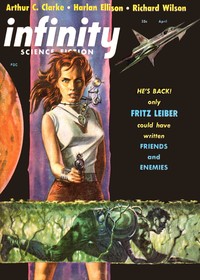
Before opening Friends and Enemies — Context and Discussion, the edition data offers a quick orientation: 9,350 words, 41 min estimated reading time, and 1 detected text section.
The text analysis averages about 13.7 words per sentence, while the detected sections provide another way to judge how the source is divided.
Project Gutenberg metadata also associates the work with “Science fiction,” connecting these edition facts with the source record’s subject description.
Explore this collection
These alternatives are selected using recorded categories and estimated reading time.
About 41 minutes
Machines Invention
9,204 recorded words. 0 minutes difference from this book's estimate.
View Gutenberg source #64827About 41 minutes
Machines Invention
9,403 recorded words. 0 minutes difference from this book's estimate.
View Gutenberg source #68233About 31 minutes
Machines Invention
6,997 recorded words. 10 minutes difference from this book's estimate.
View Gutenberg source #66283Search stored excerpts and compare books → Choose by your preferences →
Choices use stored catalog measurements. Estimates vary with reading speed. A shared category is a catalog label, not a claim that two books have the same argument or literary quality.
Search reads excerpt text stored with this catalog and links to its associated Gutenberg record. The connection is stored in the site database; this tool does not recheck that every excerpt is word-for-word identical to that external record. Excerpt search does not cover every chapter and does not verify historical publication dates.
Catalog snapshot checked: 2026-09-25. Coverage: 90 public books, 90 available source excerpts.
Calculated from edition completeness, EPUB availability, text structure and catalogue metadata. Not a user rating.
Total of 100 points, scaled to a 2.5-5.0 range. Editions with an empty description or a missing EPUB file are not scored.
Public-domain source text
The source text is kept in the dedicated reader, separate from this catalogue record and its commentary.
The story opens with a tense expulsion scene at dawn: two professors, Ellenby (a former nuclear physicist) and Madson (a vocal anti-science advocate), are driven out of Ozona College by a fat man who embodies the town's rejection of science. The setting immediately establishes a world where scientific knowledge is criminalized—Ellenby is exiled for his past as a physicist, while Madson, despite his lifelong crusade against science, is also cast out. The dialogue reveals a society that has turned violently against intellect, with the fat man boasting of helping to burn down Cal Tech. This opening efficiently introduces the central conflict: the collision between art and science in a world shattered by super-bombs.
The narrative moves through a series of hostile encounters that escalate without warning. After their expulsion, Ellenby and Madson are picked up by a wealthy actress, Rickie, whose frivolous demeanor contrasts with the looming threat of renewed bombing. Her chauffeur, George, is drunk and jittery, hinting at the pervasive fear. The journey is abruptly interrupted when a gang led by Harvey ambushes them. Harvey's men appear from nowhere, armed with everything from shotguns to rapid-fire weapons, and the violence is sudden and absurd: Rickie's four-foot hat lands on a gunman, causing him to fire at the sky. The scene underscores the randomness of danger in this world, where even a hat can become a weapon.
When Harvey's gang searches the professors, they seize two objects that crystallize the story's thematic tension: Madson's volume of Keats and Ellenby's spectroscope. Harvey dangles the Keats by a stray page, treating poetry as contraband, while the spectroscope—a scientific instrument—prompts the gang to label Ellenby a “science gadget” user. These items are not mere possessions but evidence of allegiance in a world where both art and science are suspect. The gang's leader, Harvey, declares there has been “too much science in the world and too many words,” equating intellectual pursuits with the bombs that destroyed civilization. The confiscation of these objects signals that the professors' identities are now liabilities.
The story complicates the initial art-versus-science binary by showing how characters shift sides based on circumstance. Madson, who has devoted his life to opposing science, is nonetheless expelled alongside a scientist. Rickie, a film star, dismisses official news and relies on her psychic counselor, yet she owns a jet car and employs a chauffeur—trappings of technology. Even the gang members are a motley mix: one wears a gold kimono, another a filthy white lace dress, suggesting that social roles have collapsed. The professors themselves are forced to cooperate despite their ideological differences. The narrative suggests that in a broken world, the categories of “friend” and “enemy” are fluid, determined less by belief than by survival.
Leiber uses sensory details to evoke a parched, deteriorating environment. The sun is already hot before it has fully risen; the road is dusty; a dead eucalyptus leaf catches Ellenby's eye. Spittle curls in the dust “like a little brown worm.” These images of dryness and decay mirror the moral and social desiccation of the post-bomb world. The spires of New Angeles gleam “dusky blue,” a distant promise that remains unreachable. Even the jet car's blast is described as “hot,” and the wheat near the bridge is dry enough to conceal a gunman. The physical landscape reinforces the sense of entropy, where every element—from the sun to the characters' sweat—contributes to an atmosphere of imminent collapse.
The excerpts present only the opening chapters of a longer story, so the full arc of Ellenby and Madson's journey remains unknown. However, the patterns established—sudden violence, the weaponization of objects, and the blurring of ideological lines—suggest a narrative that resists simple resolutions. Readers should attend to how Leiber uses setting and incidental details to build tension, and how the initial opposition between art and science may be subverted as the plot unfolds. The story's title, Friends and Enemies, hints at a world where trust is provisional and alliances shift with each encounter.
Reading Friends and Enemies, I kept thinking about the old pulp underneath the dust, that strange underground journey in The Wolf-Men: A Tale of Amazing Adventure in the Under-World — Inside the Classic. Both feel like survival hinges on what you carry in your head, not what you hold in your hands. It’s a quieter terror, that thought, and it lingers long after the pages close.
Capture what you thought, learned, and would like to remember.