1

The Sling and the Stone — Reading Companion
(0 User reviews)
67
Project Gutenberg
2021
Not confirmed
Science fiction; Short stories; Space stations -- Fiction; Satellites -- Fiction; Weapons -- Fiction; Russians -- Fiction
Readers of public-domain and historical texts
Project Gutenberg digital edition
en
Edition facts
Words
7,829
Reading time
35 min
Text sections
1
The Sling and the Stone — Reading Companion can be approached with a clearer sense of reading commitment from its source measurements: 7,829 words, 35 min estimated reading time, and 1 detected text section.
The text analysis averages about 14.6 words per sentence, while the detected sections provide another way to judge how the source is divided.
Project Gutenberg metadata also associates the work with “Science fiction,” connecting these edition facts with the source record’s subject description.
Source:
Project Gutenberg record #66292
A Soviet scientist on a secret space station discovers his calculations for a redirected asteroid have been sabotaged, leading to a confrontation with his superiors and a choice between duty and conscience.
Editorial Edition Score
4.4/5
★★★★★
★★★★★
Calculated from edition completeness, EPUB availability, text structure and catalogue metadata. Not a user rating.
How this score is calculated
- Description quality20 pts
- Title & short description10 pts
- Source metadata20 pts
- Text length15 pts
- Chapters / structure15 pts
- EPUB file integrity20 pts
Total of 100 points, scaled to a 2.5-5.0 range. Editions with an empty description or a missing EPUB file are not scored.
Edition quality
Read the Text
There were some very bad minutes. For a while he weighed several tons and could not move, and then he weighed nothing at all and was sick. Someone else unstrapped him and gave him pills, and then thoughtfully tied him to a handring on the wall. And at long last his mind began to accept it.
The incredible Soviet had succeeded. His Russian contemporaries had put a manned vessel in outer space.
Diavilev sat quietly stupefied.
That the spouting, unshaven, preposterous baboons with whom he had worked could have built this thing seemed to him blankly impossible. Being one himself, Pyotr Diavilev had no great respect for what Russian scientists the great many purges had left. But of course there the thing was. Built by Germans perhaps, with secrets stolen from the Americans while they haggled about peace; nevertheless, there the thing was.
And if he was going up now there could be only one place to go and therefore he was not a prisoner at all. The wonder and relief of it was too much at once. He surrendered himself to awe. When the time came to board the satellite he was poised and ready.
In the midst of a curving room hung and inset with a thousand shining gadgets, Pyotr Diavilev floated in the air. A black-browed man took his arm carefully and pulled him to the floor, placed magnetic-soled shoes on his feet. Diavilev could not help grinning delightedly. The dark man, whose name was Krylov, stood thoughtfully and absently scratching his cheek.
"Now as to why you are here," he said, and Diavilev tensed and waited. There were three other men in the room, but no one moved.
"You understand of course what this station is, and that the building of it places us, our people, in control of the world."
"Atomic missiles launched from this base may be guided exactly to any point on the surface of the Earth that we select, yet the station itself represents so small and distinct a target as to be virtually invulnerable. Russia, my friend, need fear no country on Earth. Not," he added quickly, "that she ever did, of course."
Diavilev, with the inbred habit of years, gave his congratulations. Krylov stood looking at him closely, half-smiling, rubbing again at his cheek. There was something infinitely chilling in the moment, but Diavilev was able to smile back.
"This station has been in existence," said Krylov, "for slightly more than a week. There are not fifty people in the entire world who know of it. You have become one. You are therefore most important."
Diavilev was becoming nervous.
"But you are important," Krylov went on slowly, "for other reasons. To be exact, you are perhaps as important at this moment as any man who ever lived."
Diavilev, dazed, struggled to digest that while Krylov held him with his eyes and the three other men spoke lowly among themselves.
"I am saying all this to impress upon you the vastness of the work with which you have been entrusted. I want you to understand clearly that the accuracy of your work could mean the collapse of all our enemies, of the entire capitalistic empire. Therefore you _will_ be accurate."
There was a fixity to Krylov's face which was unsettling. Diavilev waited, uneasy and bewildered. The dark man smiled.
"You are a Russian," he stated powerfully. "We know that you will do your best."
"Of course," Diavilev said.
Krylov turned and pulled open a drawer. Out of the drawer he drew a chart and handed it to Diavilev.
"Do you recognize that?"
"That is the plotted orbit," Krylov said carefully, "of a moon. It is not of course the moon with which you are familiar. But it is a moon circling the Earth, a _second_ moon.
"It is a moon of which no one knows, excepting ourselves and the Kremlin. We discovered it shortly after we arrived, when it passed quite near the station. It is small and dark, too small and non-reflecting to be seen from Earth. It is approximately five miles wide.
Diavilev who had had to digest a great many things in a very short while, was able to nod. Because this was, after all, Diavilev's field.
A second moon, he told Krylov, speaking with some excitement, had long been predicted by astrophysicists everywhere. Since the Earth had been attracting meteors for something like two billion years, it was inevitable that _some_ at least should be captured as moons.
Krylov broke in, nodding with impatience.
The story opens with the inflation of a space station—a "silvery doughnut"—and the matter-of-fact arrival of four Soviet cosmonauts: Krylov, Mirkov, Stolyakhin, and Davchenko. There is no ceremony, only the quiet work of attaching carbon-coated aluminum slabs and trailing wires. The narrative voice is detached, almost clinical, as it describes the first day, then the second day filled with "a great awe," and the third day when loneliness begins. This measured pacing establishes a sense of isolation and routine that will be shattered.
The Weight of a Name: Allusions and Irony
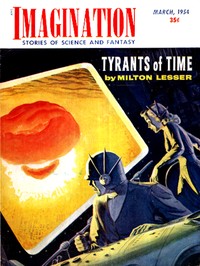
The title The Sling and the Stone evokes the biblical story of David and Goliath, but the excerpts never directly reference that tale. Instead, the irony lies in the weapon itself: a moonlet redirected to strike Earth. The "stone" is a celestial body; the "sling" is Soviet engineering. The story’s original publication in Imagination Stories of Science and Fantasy (March 1954) places it in the Cold War era, and the title’s underdog connotation is subverted—here, the powerful (the Soviet state) wields the sling. The protagonist, Pyotr Diavilev, is a scientist whose name suggests a link to the Russian word for "devil" (dyavol), hinting at his role as a potential betrayer. Yet the narrative withholds judgment, focusing instead on his internal experience.
The Texture of Suspicion: Voice and Gesture
Shaara builds tension through small, telling details. When Diavilev is arrested, the army man asks for a cigarette, and Diavilev realizes he has forgotten his glasses. The army man’s unexpected courtesy—"We will get them"—lowers Diavilev’s fear, but the reader senses a trap. Later, Krylov’s smile is described as "looking quite deep into Diavilev's eyes," a gesture that feels both friendly and predatory. The dialogue is spare: Krylov’s final accusation, "Did you think we trusted you?" is delivered "flat and dispassionate," while Diavilev’s response is silence. The story relies on what is left unsaid, and on physical actions—turning down the radio volume, rising wearily—to convey emotion.
Space as a Stage for Moral Choice
The setting is not merely backdrop but an active force. The station is a "silvery doughnut" floating in "the cold of space," and the moonlet is "huge and black and permanent." Diavilev’s decision to step onto the moonlet’s surface is described as setting foot on "an alien world," a moment of wonder that completes his life. But that wonder is undercut by Krylov’s revelation: the trajectory has been corrected, and the meteor will strike the U.S. capital. Diavilev is left alone on the moonlet, facing a choice between allowing the strike or sabotaging it—a decision the excerpts leave unresolved. The story uses the vastness of space to magnify the weight of individual action.
Readers should pay attention to the story’s structure: it alternates between the station’s daily routine and Diavilev’s flashback to his arrest, creating a layered timeline. The excerpts do not reveal the ending, so the moral dilemma remains open. The catalog subjects list "Russians" and "weapons," but the story is less about geopolitics than about personal integrity under surveillance. The prose is lean, with no wasted words—every detail, from the forgotten glasses to the radioed correction, serves the central conflict.
That moment when the scientist realizes the numbers don’t lie—and neither does his own quiet dread—stayed with me long after I closed the book. It reminded me of the ache in Bleekman's Planet — Themes and Context, where duty and conscience weigh the same heavy coin. Some stories just sit beside you, waiting to be remembered.
There are no reviews for this eBook.
There are no comments for this eBook.
Reader reflection
Record your reading impressions
A brief reflection can help important ideas stay with you longer.
Your progress
0
/
10
2
What was your overall reaction to the book?
3
Would you pass this book on to a friend?
4
How easy was the book to follow?
5
Would you start a conversation about this book?
6
Do you expect to return to this book?
7
How well did it match your expectations?
8
How understandable was the text?
9
What did this book teach you most?
10