About 68 minutes
The Firing Line — Key Ideas to Explore
Space Future
15,588 recorded words. 0 minutes difference from this book's estimate.
View Gutenberg source #68001
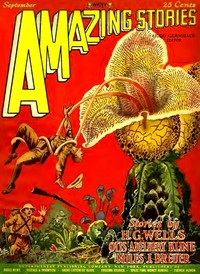
This digital edition of The colour out of space — Context and Discussion is described by source-level measurements including 15,593 words, 1 hr 8 min estimated reading time, and 2 detected text sections.
The text analysis averages about 22.3 words per sentence, while the detected sections provide another way to judge how the source is divided.
Project Gutenberg metadata also associates the work with “Science fiction,” connecting these edition facts with the source record’s subject description.
Explore this collection
These alternatives are selected using recorded categories and estimated reading time.
About 68 minutes
Space Future
15,588 recorded words. 0 minutes difference from this book's estimate.
View Gutenberg source #68001About 61 minutes
Space Future
14,000 recorded words. 7 minutes difference from this book's estimate.
View Gutenberg source #64746About 49 minutes
Space Future
11,158 recorded words. 19 minutes difference from this book's estimate.
View Gutenberg source #64782Search stored excerpts and compare books → Choose by your preferences →
Choices use stored catalog measurements. Estimates vary with reading speed. A shared category is a catalog label, not a claim that two books have the same argument or literary quality.
Search reads excerpt text stored with this catalog and links to its associated Gutenberg record. The connection is stored in the site database; this tool does not recheck that every excerpt is word-for-word identical to that external record. Excerpt search does not cover every chapter and does not verify historical publication dates.
Catalog snapshot checked: 2026-09-25. Coverage: 90 public books, 90 available source excerpts.
Calculated from edition completeness, EPUB availability, text structure and catalogue metadata. Not a user rating.
Total of 100 points, scaled to a 2.5-5.0 range. Editions with an empty description or a missing EPUB file are not scored.
Public-domain source text
The source text is kept in the dedicated reader, separate from this catalogue record and its commentary.
The story opens with a surveyor's matter-of-fact report of a place locals call the 'blasted heath,' a tract of land so unnerving that 'foreigners do not like to live there.' The narrator's initial skepticism—he assumes the evil is 'something which grandmas had whispered to children through centuries'—establishes a rationalist perspective that will be gradually eroded. The landscape is described with precise, unsettling details: 'dark narrow glens where the trees slope fantastically,' and 'squat, moss-coated cottages brooding eternally over old New England secrets.' This opening immediately signals that the horror is rooted in the physical environment, not in supernatural folklore.
The narrative is filtered through two key perspectives: the unnamed surveyor, who frames the story as a retrospective investigation, and old Ammi Pierce, the only remaining resident who 'dares to talk of the strange days.' Ammi's reliability is subtly undermined early on—his head has 'been a little queer for years'—yet his account forms the core of the tale. The landscape itself becomes a character, described in terms of decay and abandonment: 'the wide chimneys crumbling and the shingled sides bulging perilously.' The surveyor's rational approach contrasts with Ammi's fragmented, sensory memories, creating a tension between objective observation and subjective experience that the reader must navigate.
Lovecraft avoids describing the alien entity directly, instead focusing on its effects. The meteorite that falls on Nahum Gardner's farm is not a rock but a source of 'a kind o' smoke' and a colour 'jest the same, like the flowers an' plants.' This colour is never named—it is simply 'the colour,' an absence in the spectrum that defies human categorization. The excerpts show how it manifests: a 'pale phosphorescence' on woodwork, a 'luminosity of all the woodwork in sight,' and a 'faint but unmistakable' glow. The horror lies not in a visible monster but in a pervasive, sucking presence that 'burns an' sucks' life from everything it touches.
The excerpts trace the slow disintegration of the Gardner family through Ammi's recollections and Nahum's dying words. Nahum's final speech is a stream of broken observations: 'Thad an' Merwin an' Zenas ... everything alive ... suckin' the life out of everything.' The colour 'beats down your mind an' then gits ye,' suggesting a psychological as well as physical corruption. The family members vanish one by one—Zenas 'never come back from the well'—and the house itself becomes a site of 'horrible brittleness' and 'dry fragments.' Lovecraft builds dread through accumulation of detail rather than explicit violence, leaving much to the reader's imagination.
The well on the Gardner property emerges as a focal point of the contamination. Ammi's horse bolts after hearing a 'liquid splash' from the well, and Nahum's final words confirm its role: 'it lived in the well.... the well shone at night.' The colour 'pizens' the water, turning it into 'evil water' that draws victims in. The surveyor's initial description of the 'blasted heath' hints at a future where the site will be 'flooded for the new reservoir,' suggesting that the contamination will be submerged but not destroyed. The well becomes a symbol of hidden, ongoing threat—a source of horror that remains active even after the immediate crisis passes.
Readers should pay close attention to Lovecraft's use of sensory details—the 'detestably sticky noise' of suction, the 'pale phosphorescence' on wood, the 'cleft, bulging lips' of Nahum's final moments. The story's power lies not in plot twists but in the gradual accumulation of uncanny impressions. The surveyor's frame narrative invites the reader to piece together the truth from fragmented testimony, much like an investigator at a crime scene. Trust the landscape; it holds the key to the horror.
That tale of the poisoned heath stayed with me long after, that creeping sense of time itself turning wrong. It made me think of another one, Equation for Time — Story, Setting & Ideas, which feels like a quieter, more personal echo of that same strange ache. Some stories just leave a shadow in the mind.
Create a short personal record of your experience with this book.