About 136 minutes
Children of the Chronotron — Themes and Context
Other Worlds
31,129 recorded words. 10 minutes difference from this book's estimate.
View Gutenberg source #66005
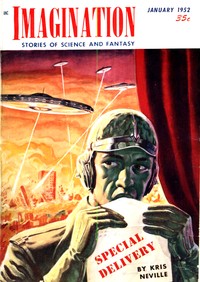
Special Delivery — Background and Themes can be approached with a clearer sense of reading commitment from its source measurements: 28,846 words, 2 hr 6 min estimated reading time, and 3 detected text sections.
The text analysis averages about 10.6 words per sentence, while the detected sections provide another way to judge how the source is divided.
Project Gutenberg metadata also associates the work with “Science fiction,” connecting these edition facts with the source record’s subject description.
Explore this collection
These alternatives are selected using recorded categories and estimated reading time.
About 136 minutes
Other Worlds
31,129 recorded words. 10 minutes difference from this book's estimate.
View Gutenberg source #66005About 115 minutes
Other Worlds
26,241 recorded words. 11 minutes difference from this book's estimate.
View Gutenberg source #65813About 94 minutes
Other Worlds
21,604 recorded words. 32 minutes difference from this book's estimate.
View Gutenberg source #66538Search stored excerpts and compare books → Choose by your preferences →
Choices use stored catalog measurements. Estimates vary with reading speed. A shared category is a catalog label, not a claim that two books have the same argument or literary quality.
Search reads excerpt text stored with this catalog and links to its associated Gutenberg record. The connection is stored in the site database; this tool does not recheck that every excerpt is word-for-word identical to that external record. Excerpt search does not cover every chapter and does not verify historical publication dates.
Catalog snapshot checked: 2026-09-25. Coverage: 90 public books, 90 available source excerpts.
Calculated from edition completeness, EPUB availability, text structure and catalogue metadata. Not a user rating.
Total of 100 points, scaled to a 2.5-5.0 range. Editions with an empty description or a missing EPUB file are not scored.
Public-domain source text
The source text is kept in the dedicated reader, separate from this catalogue record and its commentary.
The story opens with a silver listening post zipping across a moonlit desert under cannon fire, a radar-controlled gun chuckling as it brings the device down. This is not a human weapon but an alien reconnaissance tool, destroyed by its own handlers to leave no trace. The narrative immediately establishes a pattern: the Knougs, the unseen invaders, prepare for D-Day while Earth's authorities dismiss the incident as a failed attempt to shoot at Venus. The reader is placed in a world where the mundane—a bus ride, a cigar, a fare—masks an elaborate alien infiltration. Parr, the first advanceman to land, wears a conservative suit and carries imitation coins, yet his anti-grav pack and mental liaison with other agents reveal the true stakes. The opening chapters efficiently build a tension between the ordinary and the extraordinary, a contrast that will define the reading experience.
Parr's arrival is marked by careful mimicry: his suit, cigar, and coins are "excellent imitations," yet small errors—trying to hand coins to the driver, not understanding the fare box, needing to be told about the smoking ban—expose the gap between imitation and genuine familiarity. These details are not mere color; they establish a pattern of observation and adaptation. The bus scene, with its mundane instructions and the driver's casual corrections, grounds the alien invasion in the banal routines of 1950s Los Angeles. The reader watches Parr learn, furtively studying the occupants while attempting mental contact with other advancemen, only to encounter a "hazy swirl of interdiction." This early failure hints at resistance, though the source remains unclear. The narrative voice, clipped and matter-of-fact, mirrors Parr's own detachment, making his growing exhaustion and fear later in the story all the more striking.
By Chapter VIII, the tone shifts from cool reconnaissance to desperate flight. Parr, now hunted by two Oholos—deadly alien pursuers—phones the warehouse to check on mailings while his body "was clogged and stuffy and sluggish." The prose becomes fragmented, mirroring his fatigue: "Eat, run. Always, now, he was running." The city itself becomes a labyrinth: "up Main—to the suburbs—to the ocean—back to Main again—down the speedway to Pasadena and through Glendale to Main." This repetition conveys the grinding cycle of evasion. A key moment occurs when Parr, in anguish, admits he does not want to see the buildings made rubble, a flicker of empathy that complicates his mission. The Advanceship's response—"You better stay. You'll be safer there"—rings hollow, and Parr's sob, "They'll catch me!" undercuts any sense of control. The excerpt ends with him phoning airports, the pursuit relentless.
The central conceit—that the invasion is executed via postal delivery—is introduced early but its mechanics remain deliberately vague in the excerpts. Parr's mission is "to see that every person received a package that was being mailed," and the story's title, Special Delivery, underscores this. The warehouse hums with activity: "parcels being moved, trucks being loaded ... cursing and laughing and subdued shouting." This mundane logistics operation contrasts sharply with the alien technology and deadly pursuit. The reader is left to infer the nature of the packages; the excerpts offer no explanation of their contents or effects. What is clear is that the mailing is scheduled for D-Day minus four, and that Parr's role is nearly complete—"Everything's scheduling. In a few hours now it'll be all over." The invasion is not a battle but a bureaucratic process, a chillingly efficient plan that makes the personal drama of Parr's flight all the more poignant.
Neville's prose is lean and functional, favoring short sentences and concrete details. The opening paragraph uses active verbs—"zipped," "twisted," "chuckled," "plunged"—to create a sense of immediate action. Dialogue is sparse and often transactional, as in the bus exchange: "Thirty cents, buddy." "Put it in the box, buddy." This flatness extends to Parr's internal monologue, which becomes more fragmented as his ordeal progresses. The narrative structure alternates between external action and Parr's weary thoughts, creating a rhythm of chase and reflection. Notably, the excerpts provide no direct access to the Knougs' perspective or the Oholos' motives; the reader is confined to Parr's limited, increasingly unreliable viewpoint. This restriction heightens the sense of isolation and uncertainty, making the story's world feel both immediate and opaque.
Readers approaching Special Delivery should attend to the tension between the alien's clinical observation and his growing human vulnerability. The excerpts offer a fragmented view—the opening's cool setup, the middle's frantic chase, and the later hints of moral doubt—but leave key questions unanswered: What is in the packages? Who are the Oholos? Does Parr's treason succeed? The story rewards attention to small details, like the imitation coins or the bus driver's check, which ground the fantastic in the everyday. Approach the text as a puzzle of perspective, where the invasion is both a plot device and a mirror for Parr's internal conflict.
Reading about Parr’s reluctant tenderness for the people he’s meant to destroy, I kept thinking of another quiet ache. There is a strangeness to affection that arrives too late, when the decision is already made. That same sorrow lives in Under the Skin — Text and Context, where seeing truly means losing everything. It’s a lonely thing, that flicker of recognition.
Save your reaction, strongest insight, and memorable passage.