About 46 minutes
Run, Little Monster! — Key Ideas to Explore
Social Speculation
10,407 recorded words. 29 minutes difference from this book's estimate.
View Gutenberg source #65741
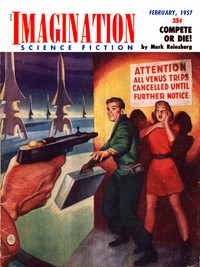
For Compete or Die! — Edition Insights, the stored edition analysis reports 17,144 words, 1 hr 15 min estimated reading time, and 2 detected text sections.
The text analysis averages about 10.9 words per sentence, while the detected sections provide another way to judge how the source is divided.
Project Gutenberg metadata also associates the work with “Science fiction,” connecting these edition facts with the source record’s subject description.
Explore this collection
These alternatives are selected using recorded categories and estimated reading time.
About 46 minutes
Social Speculation
10,407 recorded words. 29 minutes difference from this book's estimate.
View Gutenberg source #65741About 39 minutes
Social Speculation
8,894 recorded words. 36 minutes difference from this book's estimate.
View Gutenberg source #68197About 37 minutes
Social Speculation
8,497 recorded words. 38 minutes difference from this book's estimate.
View Gutenberg source #65977Search stored excerpts and compare books → Choose by your preferences →
Choices use stored catalog measurements. Estimates vary with reading speed. A shared category is a catalog label, not a claim that two books have the same argument or literary quality.
Search reads excerpt text stored with this catalog and links to its associated Gutenberg record. The connection is stored in the site database; this tool does not recheck that every excerpt is word-for-word identical to that external record. Excerpt search does not cover every chapter and does not verify historical publication dates.
Catalog snapshot checked: 2026-09-25. Coverage: 90 public books, 90 available source excerpts.
Calculated from edition completeness, EPUB availability, text structure and catalogue metadata. Not a user rating.
Total of 100 points, scaled to a 2.5-5.0 range. Editions with an empty description or a missing EPUB file are not scored.
Public-domain source text
The source text is kept in the dedicated reader, separate from this catalogue record and its commentary.
The story opens with Bart Sponsor, a self-described 'Top Competitor,' fleeing police after a routine traffic violation escalates into a high-speed chase. Reinsberg establishes the stakes immediately: Bart's internal monologue—'Bart Sponsor, fugitive'—and the physical details of a bullet hole in the windshield set a tone of desperate, breathless action. The setting is a future Chicago where the motto 'I WILL COMPETE' adorns a revolving sign atop Municipal Tower, and air traffic is stratified by social rank. Bart's contempt for 'stupid shlubs' in slower lanes reveals a society built on ruthless competition, a theme woven into the very fabric of the city's infrastructure.
Reinsberg's word choices consistently reinforce Bart's frantic state. Verbs like 'slammed,' 'fumbled,' 'gunned,' and 'lurched' convey physical urgency, while phrases such as 'desperate precision' and 'fatalism swept over me like ocean surf' reveal his psychological turmoil. The dialogue is terse and functional: 'Don't shoot! I surrender!' Bart's internal thoughts are bitter and self-aware—'I was a pillar of society'—but never introspective. The narrator's voice is that of a man who measures his worth by his competitive status, and the language reflects a world where speed, efficiency, and dominance are paramount.
Bart's narration is laced with casual contempt for those beneath him. He dismisses commuters as 'stupid shlubs' and resents sharing airspace with 'flivver-jets.' His wife Celia's teasing remark—'The airlanes should be reserved for Top Competitors only'—is met with sarcasm, but Bart's actions betray his agreement. The society is stratified into 'Top Competitors' and others, a hierarchy Bart internalizes. When his business partner Charlie Spacker questions Bart's trustworthiness, the negotiation becomes a battle of competitive wits, with Bart masking fury behind cordial words. The voice shifts from bravado to humiliation as Bart realizes his status is fragile.
The narrative is structured as a series of escalating crises, each forcing Bart to improvise. The opening chase leads to a flashback of the morning's routine, then to a tense loan negotiation, a hostage standoff, and a calculated escape through an office window. Reinsberg uses short, punchy paragraphs and abrupt transitions to mirror Bart's racing thoughts. The pacing accelerates with each scene: from traffic frustration to gunpoint, from a 'sleep bomb' to a fake alibi. The structure itself embodies the 'compete or die' ethos—every moment demands a decisive, often ruthless, action.
Recurring details reinforce the story's central theme. The 'Cad Super' aircar is a status symbol; the 'pneumatic tubes' represent an alternative for the less privileged. The 'I WILL COMPETE' motto is not just a sign but a creed that Bart lives by. The 'sleep bomb'—a non-lethal weapon—reflects a society where even violence is strategic. The mention of 'slave-mines of Mercury' as a punishment for failure underscores the stakes. These details are not decorative; they are functional, building a world where competition is the only law, and Bart's every move is a survival tactic.
Readers should attend to how Reinsberg uses Bart's limited perspective to reveal the society's values without explicit commentary. The novella's brevity (17,144 words) and fast pace mean that every line of dialogue and description carries weight. Notice how the author withholds judgment, letting Bart's actions and words speak for themselves. This is a story that rewards attention to its lean, purposeful prose and the way it constructs a world where the motto 'Compete or Die' is not hyperbole but a literal truth.
I keep thinking about Bart’s frantic race through Chicago, how winning never felt like peace. It reminded me of a quieter afternoon, years ago, when Blind Time — A Reader’s Guide made me sit still for an hour, just breathing, as if the pressure of constant doing finally let go. That felt like coming home to myself.
Save your reaction, strongest insight, and memorable passage.