About 37 minutes
Time Grabber — Text and Context
Social Speculation
8,497 recorded words. 2 minutes difference from this book's estimate.
View Gutenberg source #65977
Before opening Blind Time — A Reader’s Guide, the edition data offers a quick orientation: 8,894 words, 39 min estimated reading time, and 1 detected text section.
The text analysis averages about 14.9 words per sentence, while the detected sections provide another way to judge how the source is divided.
Project Gutenberg metadata also associates the work with “Science fiction,” connecting these edition facts with the source record’s subject description.
Explore this collection
These alternatives are selected using recorded categories and estimated reading time.
About 37 minutes
Social Speculation
8,497 recorded words. 2 minutes difference from this book's estimate.
View Gutenberg source #65977About 37 minutes
Social Speculation
8,324 recorded words. 2 minutes difference from this book's estimate.
View Gutenberg source #68203About 36 minutes
Social Speculation
8,168 recorded words. 3 minutes difference from this book's estimate.
View Gutenberg source #65350Search stored excerpts and compare books → Choose by your preferences →
Choices use stored catalog measurements. Estimates vary with reading speed. A shared category is a catalog label, not a claim that two books have the same argument or literary quality.
Search reads excerpt text stored with this catalog and links to its associated Gutenberg record. The connection is stored in the site database; this tool does not recheck that every excerpt is word-for-word identical to that external record. Excerpt search does not cover every chapter and does not verify historical publication dates.
Catalog snapshot checked: 2026-09-25. Coverage: 90 public books, 90 available source excerpts.
Calculated from edition completeness, EPUB availability, text structure and catalogue metadata. Not a user rating.
Total of 100 points, scaled to a 2.5-5.0 range. Editions with an empty description or a missing EPUB file are not scored.
Public-domain source text
The source text is kept in the dedicated reader, separate from this catalogue record and its commentary.
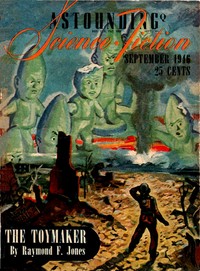
George O. Smith's Blind Time opens with a paradox: insurance adjuster Peter Wright is told to report to the Oak Tool Works at eight o'clock that evening for an accident that has already happened. The story, first published in Astounding Science-Fiction in 1946, uses this temporal twist to examine how statistical prediction collides with human experience. The catalog subjects list time travel, factories, accidents, and insurance adjusters, but the excerpts reveal a deeper focus on the psychology of workers who know an accident is certain but not who will be hurt. The narrative voice is brisk and dialogue-driven, with characters like foreman Ben Simpkins explaining the concept of 'blind time'—events that occur twice, once invisibly and once visibly. Smith avoids explaining the time mechanism in detail, instead letting the characters' reactions carry the speculative weight.
The story's central tension is between the insurance company's statistical methods and the workers' lived experience. President Porter tells Wright that the accident is 'unforeseen' yet 'forecast with certainty,' a contradiction that Wright immediately challenges: 'If this accident is forecast with certainty, why can't it be averted?' The answer—'Because it has happened already'—sets up a deterministic framework. Yet the workers do not know the victim's identity, creating a 'slight tizzy' that management deliberately maintains. Foreman Simpkins explains that identifying the victim would cause 'mental case' shock beforehand, while keeping everyone uncertain reduces the eventual trauma. This psychological calculus is more prominent than any time-travel gadgetry. The story suggests that statistical prediction, far from offering control, amplifies anxiety when applied to individual fates.
The Oak Tool Works is not just a setting but an active participant in the accident. The 'mislink crane' and its 'temporal treated section' are described in mechanical detail: 'Thin rods, jointed on toggles, floated about ten inches from the main I beam.' The workers retreat to the inside wall, watching in silence as the crane moves. Smith emphasizes the routine of 'inerting everything' and the 'mob-instinct' that keeps everyone present despite the danger. One worker recounts a previous occasion when everyone went home, but 'a thief broke in and it clipped him.' The factory thus becomes a space where inevitability is physically embodied—the crane will cause an accident, and no precaution can prevent it. This setting grounds the speculative premise in industrial realism, making the abstract concept of 'blind time' tangible through the looming machinery.
Smith relies heavily on dialogue to convey the story's ideas. Wright's initial confusion is voiced through a series of questions: 'But look, sir. An accident, by definition, is an unforeseen incident.' Porter's weary replies—'Wright, after you have been to the Oak Tool Works, you will become violently anti-semantic'—establish a tone of dry humor. The exchanges between Wright, Simpkins, and Ben serve to unpack the paradox without lengthy narration. For example, Simpkins explains the psychological strategy: 'Keeping the fact secret is worse than permitting free knowledge, according to them. But identifying the victim is far worse.' This conversational approach keeps the speculative elements accessible, though it occasionally sacrifices depth for clarity. The characters' voices are distinct: Porter is authoritative, Simpkins philosophical, and Ben pragmatic. Their dialogue drives the plot forward, as Wright moves from skepticism to reluctant acceptance of the fatalistic logic.
Blind Time is a compact story that rewards attention to its dialogue and setting details. Readers may notice how Smith uses the insurance adjuster's perspective to frame the paradox—Wright is both an outsider and a professional trained to question certainty. The story does not resolve the philosophical questions it raises about fate and free will, instead leaving the reader with the image of workers holding their breath for two hours. For those interested in mid-century science fiction's treatment of probability and psychology, this story offers a focused example of how industrial settings can serve speculative ends.
Reading Blind Time — A Reader’s Guide, I kept returning to that quiet ache of inevitability—the way the factory workers learned to live inside a certainty they couldn’t shake. It reminded me of old notes beside Man-Trap — Themes and Context, where the same weight lingers, only softer, like a door closing in another room. Strange how two distant stories share that same hush.
Capture what you thought, learned, and would like to remember.