
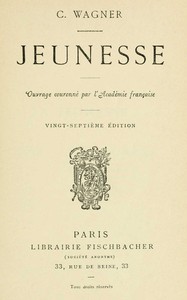
Jeunesse by Charles Wagner
Published in 1895, Charles Wagner's Jeunesse (which simply means 'Youth') is a book of ideas, not a novel. Don't open it expecting a plot with characters and events. Instead, think of it as a long, thoughtful essay or a series of connected reflections. Wagner, a French pastor and writer, uses 'youth' as a lens to examine life itself. He talks about the energy and hope we associate with being young, but he quickly moves beyond age. For him, true youthfulness is a quality of spirit—a way of living with honesty, directness, and a sense of wonder.
The Story
There isn't a traditional story here. The book's structure is more like a guide. Wagner walks us through different aspects of life—work, faith, love, nature, and society—and asks us to approach them with a 'young' heart. He argues against stuffy tradition, empty social rituals, and the kind of sophistication that makes people cold and cynical. He champions simplicity, hard work done with passion, and a genuine connection to the natural world. The 'journey' is the reader's own, as Wagner's words encourage you to strip away pretense and rediscover what matters.
Why You Should Read It
I picked this up out of curiosity about an old bestseller and was stunned by how relevant it felt. Wagner is diagnosing a problem we know all too well: burnout, feeling disconnected, and the pressure to perform. His cure isn't a new app or a productivity hack; it's a return to basic values. His writing is clear and forceful, without being preachy. When he praises the dignity of manual labor or the peace found in a walk through the fields, it doesn't feel old-fashioned—it feels like a needed reminder. Reading Jeunesse slowed my mind down. It made me question what 'busy' really achieves and why we often complicate simple joys.
Final Verdict
This book is a hidden gem for anyone feeling a bit jaded or overwhelmed by modern complexity. It's perfect if you enjoy the thoughtful essays of someone like Henry David Thoreau or the comforting clarity of Marcus Aurelius. It’s also a great, short read for history-minded readers curious about the values of a past era. Fair warning: it comes from a specific time and place (late 1800s France), so some references are dated. But the core message—that a vibrant life is built on sincerity, purpose, and simplicity—cuts through the decades with surprising power. Keep a highlighter handy; you'll want to remember these lines.
You are viewing a work that belongs to the global public domain. Knowledge should be free and accessible.
Nancy Jones
7 months agoI took detailed notes while reading through the chapters and the wealth of information provided exceeds the average market standard. A trustworthy resource that I'll keep in my digital library.
Nancy Gonzalez
1 year agoA must-have for graduate-level students in this discipline.
Elijah Lee
1 year agoFast paced, good book.
Mason Clark
11 months agoI didn't expect much, but the pacing is just right, keeping you engaged. I would gladly recommend this title.








Kimberly Miller
8 months agoAfter spending a few days with this digital edition, the inclusion of diverse viewpoints strengthens the overall narrative. The insights gained here are worth every minute of reading.